Free PUWER inspection checklist
Inspect the safety-related parts that matter for your equipment and keep a clear record of what you found. This free PUWER inspection checklist helps you plan and record an inspection under Regulation 6, whether it is due at a suitable interval, follows installation or reassembly, or is needed after an exceptional event.
The template gives you room to select the checks, note how they were carried out, record faults and follow the action through. Use the risks of your equipment and the manufacturer's instructions to set the inspection scope. The person inspecting must have sufficient knowledge and experience of the equipment and the risks involved. HSE guidance on inspection of work equipment.
Free to use. No account or email required.
This checklist is provided free of charge for general information purposes only. Read full disclaimer below.
What's in the PUWER inspection checklist
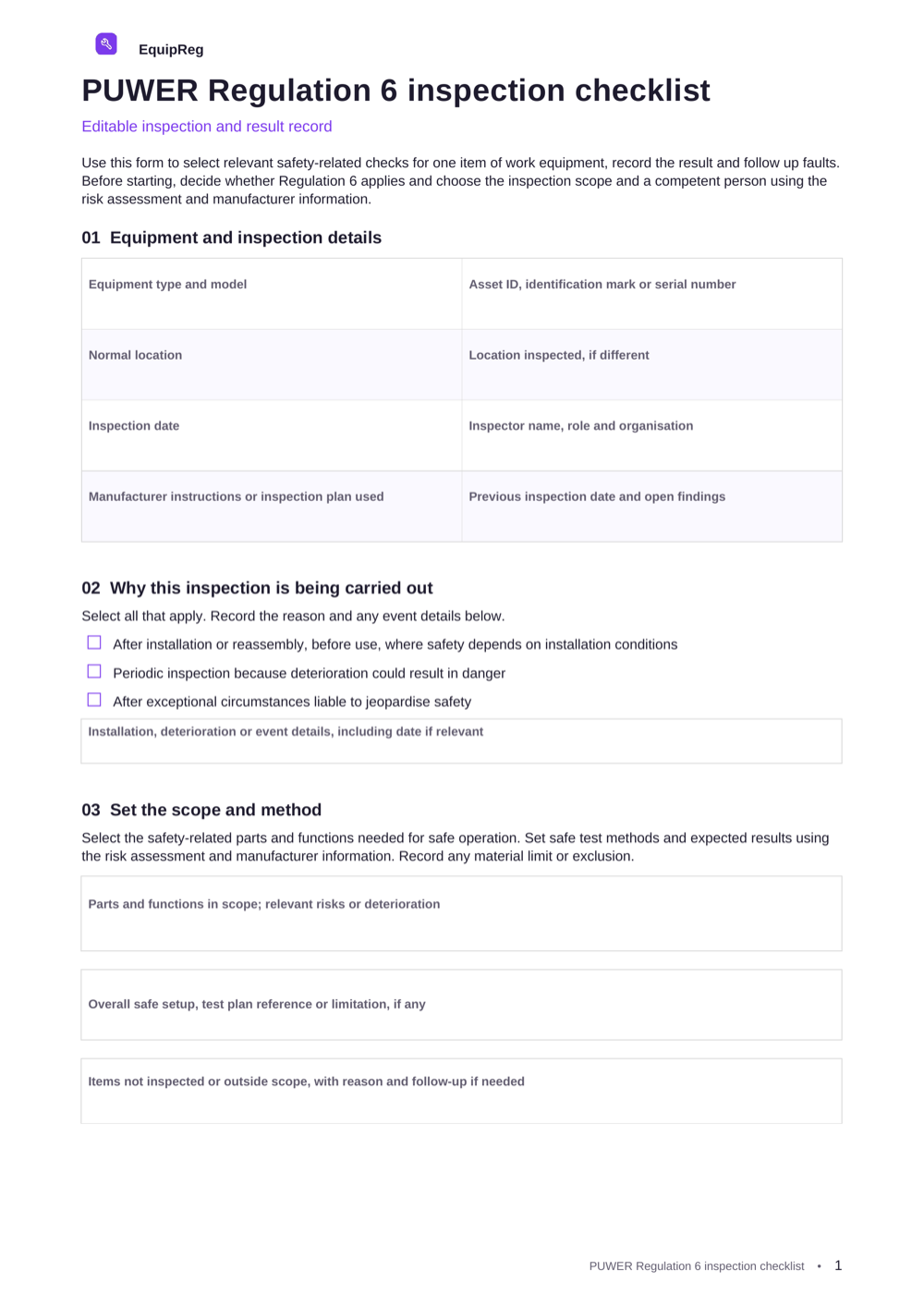
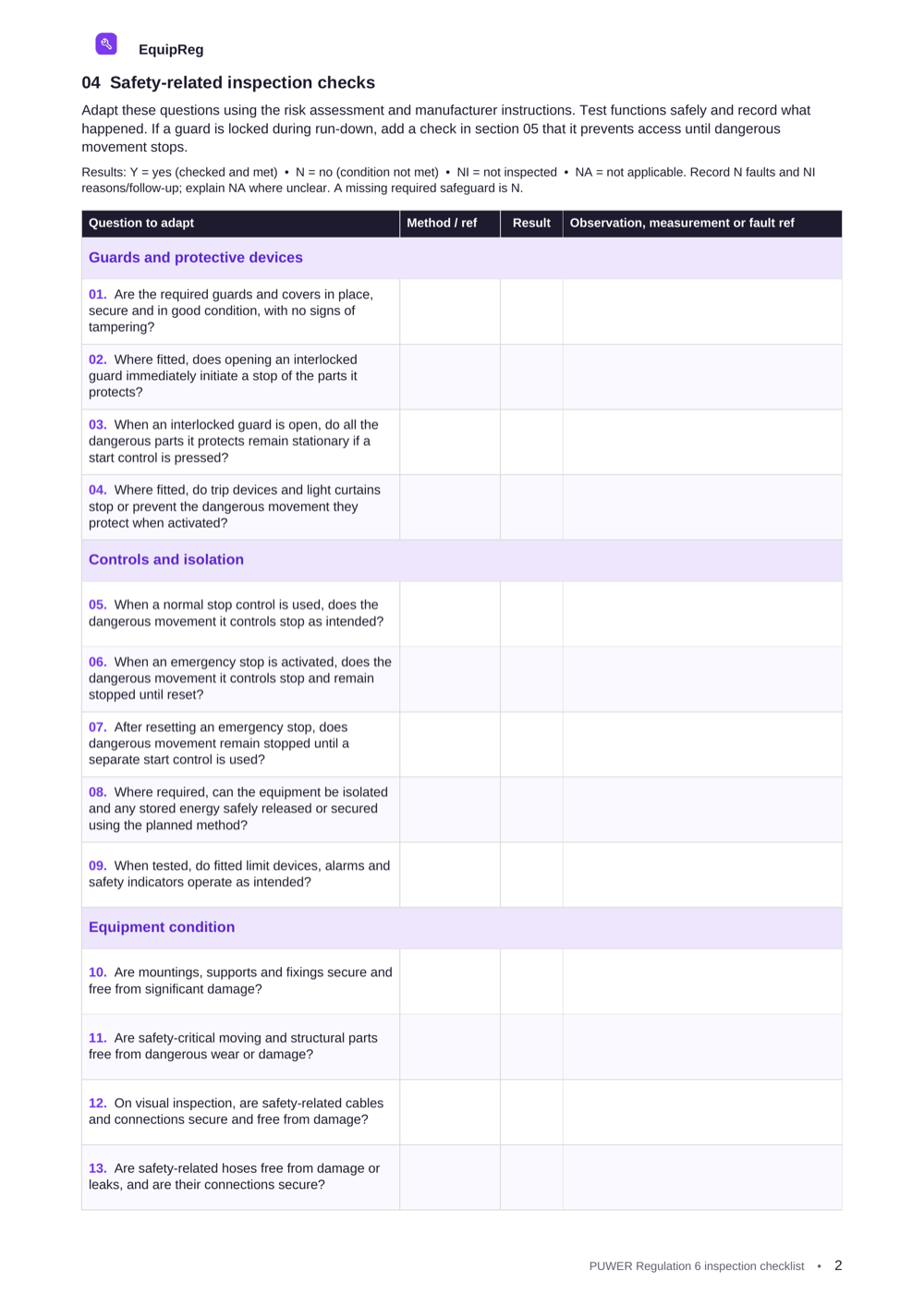
Equipment and inspection details, the reasons for the inspection, the scope and method, 13 optional safety-related questions, extra checks for the inspection reason, the result, the decision on further use and a fault block you can duplicate. It is an editable Word form, so you can type into the cells and change or delete the example checks.
When do you need a PUWER Regulation 6 inspection?
Regulation 6 sets out three circumstances. They are separate triggers, so pick the one that matches why you are inspecting.
| Reason for inspection | What it is for |
|---|---|
| After installation or reassembly | Where safety depends on installation conditions, check the equipment after installation and before first use, or after assembly at a new site or location. |
| At suitable intervals | Where deterioration could lead to danger, inspect often enough to detect and remedy it in good time. |
| After an exceptional event | Inspect after circumstances liable to jeopardise safety, such as serious damage or a major modification. |
Not every item of work equipment needs a formal Regulation 6 inspection. The need for one, its scope and any periodic interval depend on the risks, use, conditions and manufacturer's recommendations. Regulation 6(5) also excludes certain equipment subject to specialist inspection provisions, including lifting equipment and work-at-height equipment covered by those provisions. Covered power presses have their own PUWER examination rules. Check which regime and equipment functions are involved before choosing a template. PUWER Regulation 6, HSE inspection guidance.
How to use the checklist
- 1
Identify the equipment and why it is being inspected
Enter its type, model, identification number, location and all inspection reasons that apply. Review previous findings and relevant manufacturer information.
- 2
Choose the safety-related checks
Start with the parts and safety functions that matter for this equipment and its conditions of use. Add checks, remove irrelevant prompts and note any tests or dismantling needed. The inspection may be visual, functional or more detailed according to the risk. HSE L22, paragraphs 86 to 89.
- 3
Record the actual result
For each selected question, note the method, result and any observation. Use Y when the checked condition is met, N when it is not, NI when an applicable check was not completed and NA when the question does not apply. Explain NI, follow up N, and clarify NA where the reason is not obvious. Do not enter Y for a check you did not complete.
- 4
Act on faults
Record the fault, who was told, any immediate restriction on use, the action needed and when it was completed. Keep the inspection result until the next Regulation 6 inspection result is recorded. PUWER Regulation 6(3).
What should a PUWER inspection checklist include?
Choose checks for the equipment in front of you. Depending on its design and risks, that may mean examining guards and protective devices, safety controls, structural supports, connections, or components exposed to wear, damage or corrosion. Check a safety function only using a method that is appropriate and safe for that equipment. Previous defects and repairs may need particular attention.
The Word form groups its 13 example questions under Guards and protective devices, Controls and isolation, and Equipment condition. These headings make the form easier to scan. They are not required inspection topics. The questions ask about observable conditions rather than labels such as "emergency stop". For example, one asks whether opening an interlocked guard immediately initiates a stop of the parts it protects, and a separate question asks whether those dangerous parts remain stationary when a start control is pressed with the guard open. Initiating a stop is not always the same as coming to an immediate halt. If a guard stays locked during run-down, add a section 05 check that access remains blocked until dangerous movement stops. The form also separates emergency stopping, remaining stopped until reset, and the need for a separate start action. Select only relevant questions and record the expected outcome and safe test method. HSE's thermoforming-machine checklists show this practical question style. Their machine-specific tests and monthly frequency are not general rules for all Regulation 6 inspections. HSE L22, HSE inspection guidance.
For a periodic inspection, concentrate on safety-related deterioration since the last inspection. After installation or reassembly, examine the installation conditions and commissioning checks on which safety depends. After an exceptional event, identify what happened and examine the parts or functions it could have affected. The form has space for these extra checks alongside a common inspection record.
For example, consider a paper-cutting guillotine with a presence-sensing safety device, where the relevant risks call for Regulation 6 inspection. After installation, the inspection may check the device's position and stopping function. At suitable intervals, it may check deterioration of the device, its mountings and stopping function. After an impact, the inspector would focus on affected parts and any tests needed before use. The actual checks depend on the machine and its instructions. HSE L22, paragraphs 96 and 98.
HSE advises that checklists should be tailored to the equipment and limited to what is necessary for safety. A long list of irrelevant pass boxes can make real defects easier to miss. HSE inspection guidance.
What should the inspection record contain?
Regulation 6(3) requires the result of a Regulation 6 inspection to be recorded and kept until the next inspection under that regulation is recorded. It does not prescribe a form or a fixed set of fields. A completed checklist can serve as the record if it adequately captures the result and is retained. PUWER Regulation 6.
HSE L22, paragraph 103 suggests recording:
- 1 The equipment type and model
- 2 Any identification mark or number
- 3 Its normal location
- 4 The inspection date
- 5 Who carried out the inspection
- 6 Any faults
- 7 Any action taken
- 8 To whom faults were reported
- 9 The date repairs or other necessary action were carried out
These are suggested details, not nine mandatory fields. The template includes prompts for them, with room to update the fault and repair details after the inspection.
Questions about PUWER inspection checklists
Is a PUWER checklist legally required?
Regulation 6 requires the relevant inspection and a retained record of its result. It does not prescribe a checklist. A checklist helps the inspector work systematically and document the findings, but possessing a blank template does not meet the inspection duty. PUWER Regulation 6.
How often should a PUWER inspection be carried out?
PUWER gives no single interval for Regulation 6 inspections. For equipment exposed to potentially dangerous deterioration, choose a suitable interval taking account of the risks, manufacturer recommendations, conditions of use and inspection history. Inspect again after an exceptional event liable to jeopardise safety. HSE inspection guidance.
Is a pre-use check the same thing?
No. An operator's quick check before use helps spot obvious problems. HSE L22 paragraph 81 says that a pre-use check is not the Regulation 6 inspection and does not require a Regulation 6 inspection record. Use a short pre-use format for that task, and do not let its completion stand in for a required formal inspection. HSE L22.
Who should carry out a Regulation 6 inspection?
Someone with enough knowledge and experience to know what to look at, what to look for and what to do if they find a problem. This may be a suitable in-house person, though some equipment needs specialist expertise. The level of competence depends on the equipment and the inspection. HSE inspection guidance.
Does HSE provide an official PUWER inspection checklist?
No single Regulation 6 checklist is prescribed. HSE publishes examples for particular machines, including thermoforming machines and extrusion lines, but their checks and frequencies must not be applied unchanged to other equipment. HSE says the inspection scope should reflect the equipment's risks and manufacturer recommendations. This Word template is an adaptable starting point, not an HSE-approved form. HSE inspection guidance, thermoforming machines, extrusion lines.
Can I use the same checklist for every type of work equipment?
You can reuse the record fields, but select the actual checks and methods for each equipment type, its use, risks and manufacturer's instructions. Remove irrelevant prompts and add safety-related checks the template does not cover. HSE warns that excessive generic detail can turn inspection into superficial box-ticking. HSE inspection guidance.
What should I do if an inspection finds a defect?
Describe the fault, tell the responsible person and record what happens next. Restrict or stop use where the fault makes the equipment unsafe, then arrange suitable repair or other action and record when it was completed and verified. An applicable safety-related check that was not completed is NI, not Y, and needs a reason and a decision on further use. HSE inspection guidance, HSE L22, paragraph 103.
How long must I keep a completed PUWER inspection checklist?
Keep the recorded result until the next inspection under Regulation 6 is recorded. An electronic record is acceptable if it is held securely and can be made available when required. Keep later repair and verification details linked to the result. PUWER Regulation 6(3), HSE inspection guidance.
Keep the next inspection and its evidence in view
The template helps with one inspection. Across a fleet, you also need to know when the next inspection is due, find the last result and follow up defects. EquipReg is being built as a PUWER register for those ongoing jobs.
Not ready for PUWER register software? The free PUWER & LOLER register template (Excel) keeps every asset, due date and result in one sheet.
Join EquipReg early accessDisclaimer
This checklist is provided free of charge for general information purposes only. It does not constitute legal, health and safety, or professional advice, and is provided "as is" without warranties of any kind, express or implied. It does not determine whether Regulation 6 applies to your equipment, set an inspection interval or replace the judgement of a competent person. EquipReg accepts no liability for any loss or damage arising from its use. Statutory duties under PUWER 1998 and related regulations rest with the duty holder.